Sadržaj
STANDARD Carduelis Carduelis Balcanica
01
INTRODUCTION
Notes
The standard for Carduelis carduelis balcanica is the result of discussions with numerous ornithologists, breeders and bird-show judges, and is based primarily on the original scientific description of the subspecies. This standard arose from the need to establish a uniform basis for breeding C. c. balcanica, prompted by the large number and diversity of ‘small’ goldfinches exhibited at the international OrniSinj show. Motivated by the desire to preserve the biological diversity of our region, we hope that this standard will provide a sound foundation for future selective breeding.
In size, Carduelis c. balcanica corresponds to the nominate subspecies Carduelis carduelis carduelis (L.). Its principal distinction from the nominate subspecies is the duller, greyer coloration of all the ‘brown’ parts of the body. The brown back lacks the reddish tone characteristic of the nominate form and is instead slightly olive-grey. On the underside, Carduelis c. balcanica differs in having larger breast patches, more extensive coloration of the flanks and a more pronounced collar around the throat. Here too, the brown is not reddish-cinnamon as in Carduelis c. carduelis, but much darker and greyer, except for the collar below the neck, which is similarly pale and reddish-brown to that of the nominate form. Furthermore, balcanica is characterized by clean white areas: distinctly pure white in males and somewhat less clean, slightly greyish-white in females.
02
STANDARD
Carduelis carduelis balcanica
Lenght: 12–13 cm
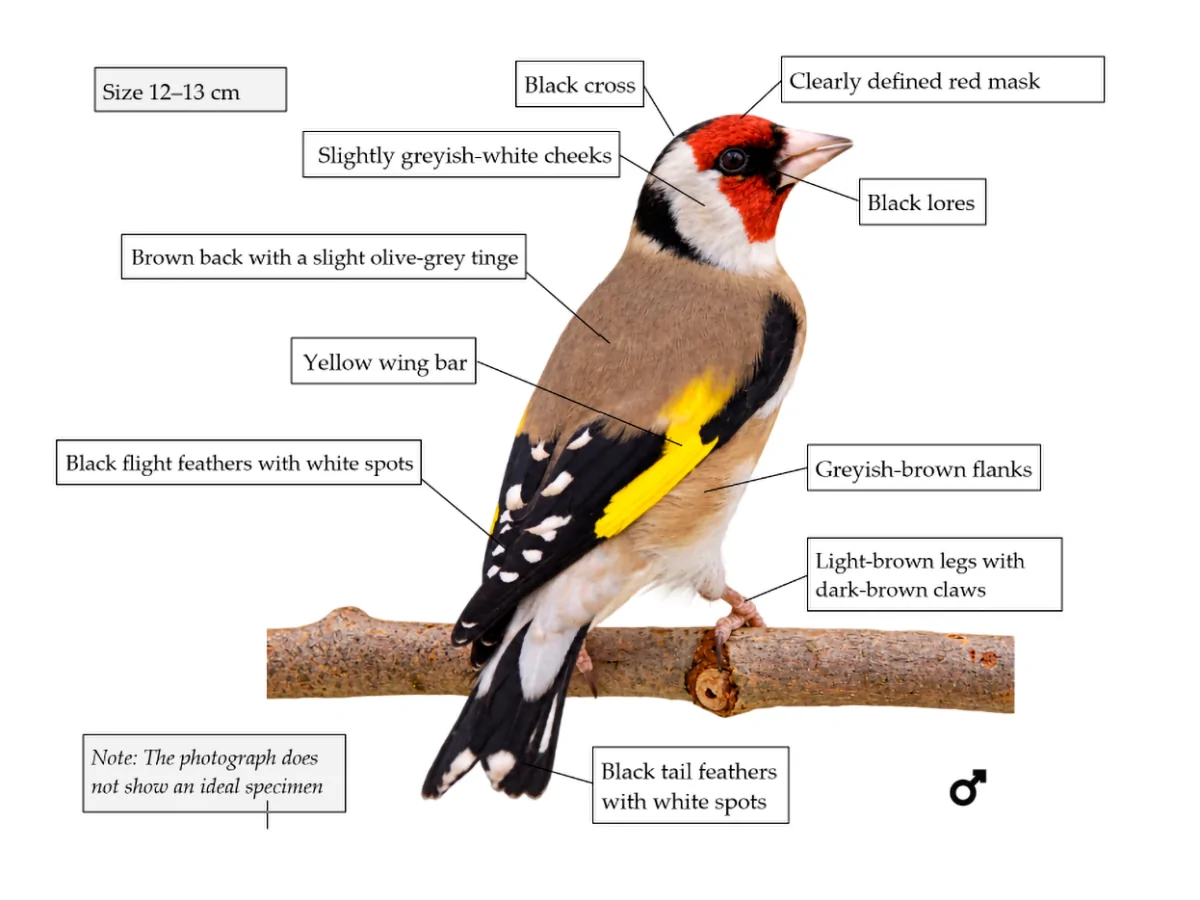
OPIS OBOJENOSTI
| BODY PART | DESCRIPTION AND CHARACTERISTICS |
|---|---|
| SHAPE | Compact and slender, yet somewhat stocky. |
| POSTURE | Upright and active. |
| BILL | Whitish-grey to muted pink (ivory-coloured), with a fairly long, dark tip. Its length must not detract from the bird’s overall proportions. |
| EYES | Dark brown. |
| HEAD | In males, the lores and bristles at the base of the bill are black, and the carmine-red mask, with slight rounding, extends behind the eye. In females, the mask reaches only halfway across the eye and is more rounded, while the lores and bristles are greyish-brown. The cross-shaped marking on the crown, in the form of an inverted T, is a broad, deep-black band extending laterally and framing the white cheeks. In females, a less intense black cross-shaped marking on the head is tolerated. |
| NECK | White, with a light-brown collar (narrow band) on the back of the neck (nape). |
| BACK | Brown with a slight olive-grey tinge (chestnut-brown with a reddish tinge, as in the nominate subspecies, is not tolerated). |
| THROAT | The red mask and white throat are well defined and clearly demarcated. |
| BREAST | Dull greyish-brown, with a smaller white, mushroom-shaped breast patch. The breast collar is pronounced, unbroken and clearly defined, but slightly lighter brown (with a reddish tinge, as in the nominate subspecies). |
| FLANKS | Brown, clearly marked and well defined, extending to the rump. A suggestion of greyish-brown streaking on the flanks is preferred. |
| BELLY | White. |
| WINGS | The primary flight feathers are black, with yellow on the outer webs in the middle; the outermost feather has no yellow coloration. The tips of the flight feathers have greyish-white terminal spots, while brownish-white is tolerated in females. In males, the shoulder coverts are black; in females, they are blackish-brown with an olive-green tinge. |
| TAIL | The feathers are black; the two outer tail feathers have an elongated white spot on the inner web. Tail feathers have white terminal spots; the upper tail coverts are black with yellowish tips, and the undertail coverts are pale with beige tips. |
| LEGS | Light brown. |
| CLAWS | Dark brown. |
03
NOTES
Typical faults
| CHARACTERISTICS | |
|---|---|
| 1 | Incorrect length. |
| 2 | Incorrect shape (excessively slender or excessively bulky; resembling the subspecies frigoris). |
| 3 | Brown coloration without a greyish tone (chestnut-brown with a reddish tinge). |
| 4 | Unclean white areas. |
| 5 | Flanks absent or excessively pronounced. |
| 6 | Mask poorly defined or insufficiently demarcated. |
| 7 | White breast patch not clearly defined. |
| 8 | Incorrect shading of the breast and flanks (the breast collar is not lighter than the rest of the breast patch, or there are black spots on the breast). |
| 9 | Incorrect wing or tail markings. |
| 10 | Incorrect colour of the nape band (intrusion of yellow into red feathers). |
Technical note
When judging, particular attention should be paid to:
| ZNAČAJKE | |
|---|---|
| 1 | Bird length (12–13 cm). Specimens which clearly belong to other subspecies on the basis of size (length and shape) (frigoris, parva or tschusii) should be declassified from the balcanica class. |
| 2 | Greyish-brown coloration of the “brown” areas (back, breast and flanks). |
| 3 | White areas (cheeks, breast patch and belly) should be as clean and pure white as possible, particularly in males. |
04
JUDGING SHEET
| Item | Description | IDEAL | START | MAX. |
|---|---|---|---|---|
| Design | Design | 30 | 27 | 29 |
| 01. Breast and flank design | Markings of the breast patch and flanks | 11 | 10 | 11 |
| 02. Head design | Design of the mask and cross | 11 | 10 | 11 |
| 03. Wing and tail design | Distribution and shape of the yellow wing bar and white markings (spots) on wings and tail | 8 | 7 | 7 |
| Colour | Colour | 30 | 27 | 29 |
| 04. Head colour | Colour of the mask, cross, cheeks, lores and nape | 10 | 9 | 10 |
| 05. Back, breast and flank colour | Brown coloration of the back, flanks and breast, including the white breast patch and belly | 10 | 9 | 10 |
| 06. Wing and tail colour | Colour of the wings, yellow wing bars and white markings (spots) on wings and tail | 8 | 7 | 7 |
| 07. Leg, claw and bill colour | Colour of the legs, claws and bill | 2 | 2 | 2 |
| Format and size | Format and size | 20 | 18 | 19 |
| 08. Length (12–13 cm) | Length of the bird (12–13 cm) | 12 | 10 | 11 |
| 09. Shape | Overall shape and proportions of the bird in relation to bill size | 8 | 8 | 8 |
| Plumage | Plumage | 10 | 9 | 10 |
| 10. Plumage | Plumage | 10 | 9 | 10 |
| Attitude, maintien & condition | Attitude, maintien & condition | 10 | 9 | 10 |
| 11. Attitude, maintien & condition | Attitude, maintien & condition | 10 | 9 | 10 |
| Total | 100 | 90 | 95* |
Important!
The maximum overall score of 95 points is not the sum of the maximum scores for the individual criteria.